 Mon-Fri: 8:00AM – 5:00PM
 1650 E Algonquin Rd. Algonquin, IL 60102
 (847) 658-9500
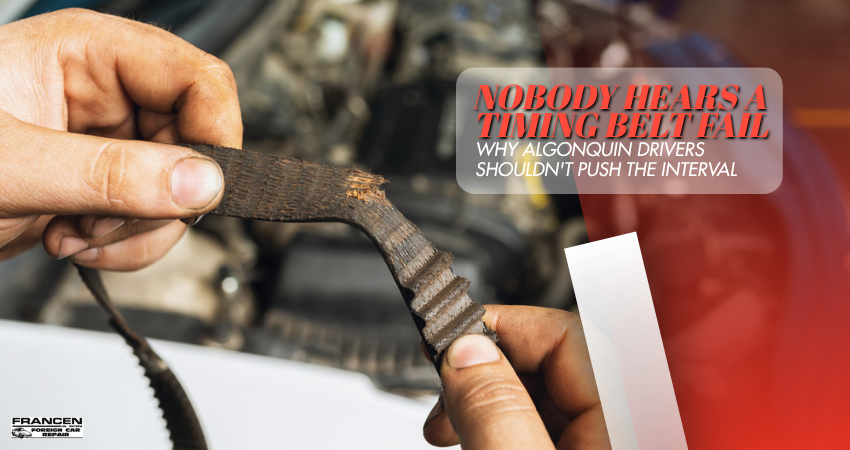
A worn brake pad squeals. A dying wheel bearing hums. A timing belt does neither. It says nothing. It runs quietly at the front of the engine, hidden behind a plastic cover, until the day a tooth shears and the camshaft stops turning while the crankshaft keeps right on going. On an interference engine — and most of what we service is one — the valves and pistons occupy the same space at that moment.
That’s the whole reason Francen & Son treats belt replacement as a date on the calendar, not a repair. We’ve been the foreign car specialist on East Algonquin Road since 1989, and every October we get the same phone call from someone whose belt was “probably fine” at 110,000 miles.
Quick Summary: Key Takeaways
- No warning symptoms: timing belts almost never announce failure, which is why replacement is scheduled by mileage and age instead of by noise.
- Interference engines lose: if the belt breaks, valves meet pistons and the repair becomes cylinder head work or a replacement engine.
- Age counts too: rubber hardens sitting still, so a ten-year-old belt with 60,000 miles is still a ten-year-old belt.
- Do the water pump with it: on most belt-driven engines the pump is behind the same cover, so replacing both at once saves the labor twice.
- Not every car has one: many newer engines use chains, so the first job is confirming which your car has.
A timing belt keeps the valves and pistons out of each other’s way
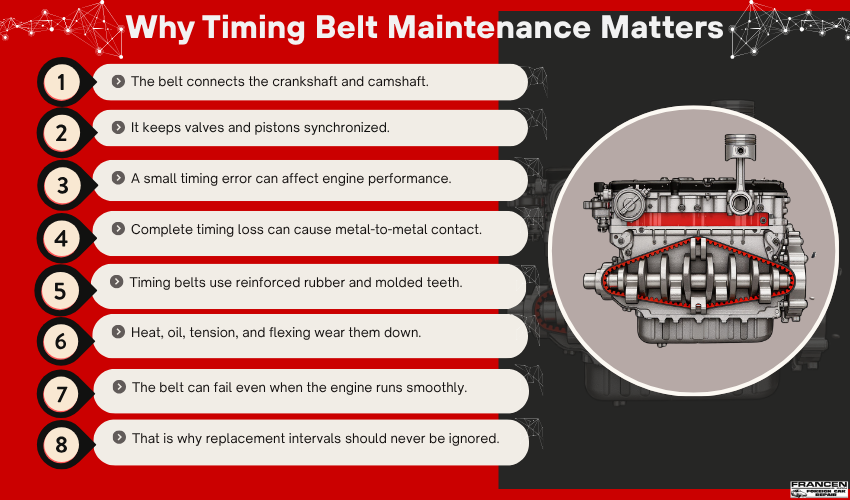
The belt ties the crankshaft to the camshaft so the valves open and close in step with the pistons. Get that relationship wrong by a few degrees and the engine runs badly. Lose it entirely? Metal meets metal.
Belts are reinforced rubber with molded teeth, and they wear from heat, oil contamination, tension and simple flex cycles. Because the cover hides all of that, you cannot judge a belt by how the car drives — a belt three miles from failure powers a perfectly smooth engine, which is exactly what makes owners comfortable ignoring the interval.
Which of our twenty makes still use a belt
Ask before you assume. Chains took over on most engines built in the last fifteen years, but plenty of cars parked in Algonquin driveways still run belts, and the owners have no idea which camp they’re in.
Older Honda and Acura V6 engines, the Volkswagen and Audi 2.0 TDI, several Subaru four-cylinders, older Volvo fives, and a long list of 1990s and 2000s European and Japanese engines are all belt-driven. Some engines even use a belt for the camshafts and a chain elsewhere. We look it up by VIN, not by badge, because guessing here has real consequences and the interval differs even between two versions of the same nameplate.
Cold Illinois mornings are hard on old rubber
A belt that has hardened with age is at its most brittle when it’s cold. First hard freeze, first cold crank, maximum stress on the teeth. That’s the pattern.
Cold weather is measurably harder on the whole engine, too. A conventional gasoline car’s city fuel economy runs roughly 15% lower at 20°F than at 77°F, according to the U.S. Department of Energy — a reminder of how much extra friction and load a winter start puts on everything turning under that cover. If your belt is at or near its interval, do it before December, not after.
Replace the water pump and tensioner at the same time
This is the part we argue with people about, and we’re right. On most belt-driven engines the water pump is driven by the timing belt and sits behind the same covers.
The labor to reach the pump is labor you’re already paying for. A pump that fails a year after a fresh belt means paying that entire teardown a second time, and a pump that starts weeping can soak the new belt in coolant and destroy it long before its interval. Tensioner and idler pulleys sit in the same category. Do the kit. Once.
What the job looks like at our shop
We confirm the engine’s belt interval, then inspect what we can reach and look at service history before quoting anything. Records beat guesses.
If the belt is due, we replace it with the tensioner, idlers and water pump, set tension to specification, and rotate the engine by hand to verify timing marks before it ever cranks. Our technicians are ASE certified, we back the work with a 12-month, 12,000-mile warranty, and free loaner cars mean the job doesn’t cost you a day off. Barrington, Crystal Lake and Huntley owners make the drive for that.
Frequently Asked Questions
Q: How often should a timing belt be replaced?
A: Most manufacturers specify between 60,000 and 105,000 miles, or seven to ten years, whichever lands first. The right answer depends on your exact engine. We verify it by VIN.
Q: What are the symptoms of a bad timing belt?
A: Usually there are none, which is the danger. Occasionally you’ll get a rough cold start, a ticking from the front cover, or a check engine light for camshaft timing. Most belts fail without any prior complaint.
Q: What happens if a timing belt breaks while driving?
A: The engine stops immediately. On an interference engine the valves and pistons collide, bending valves and often damaging the cylinder head or the pistons themselves. Then it’s a tow and major engine work.
Q: Does my car have a timing belt or a timing chain?
A: It depends on the engine, not the model year alone. Chains generally last far longer and are not on a fixed schedule, while belts are. Bring us the VIN and we’ll tell you exactly which one you have and when it’s due.
Get your timing belt interval checked in Algonquin
If you don’t know when your belt was last done, that’s your answer — find out now, while it’s a scheduled job. We’ll look up your engine and give you a straight recommendation.
Hours: Mon–Fri 8:00 AM – 5:00 PM; Sat–Sun closed
Website: francenandson.com