 Mon-Fri: 8:00AM – 5:00PM
 1650 E Algonquin Rd. Algonquin, IL 60102
 (847) 658-9500
There are few things more frustrating than a Volvo that won’t turn over — especially when the car ran perfectly the day before. Volvo’s reputation for reliability is well-earned, but like any modern vehicle loaded with sophisticated electronics, it can develop electrical faults that prevent starting. At Francen & Son in Algonquin, we’ve diagnosed no-start issues on Volvo S60s, XC90s, V70s, and the full range of models, and the cause is rarely what the driver assumes. Understanding the most common electrical culprits saves time, money, and the frustration of guessing at repairs that don’t fix the problem.
Dead Battery vs. Deeper Electrical Problem
The most frequent cause of a Volvo no-start is a discharged or failed battery, and this is often misdiagnosed because the symptoms overlap with more serious electrical faults. If you turn the key and hear rapid clicking, a single click, or nothing at all, the battery is the first thing to test — but testing matters here. A battery that reads 12.6 volts at rest may still fail under load if the cells are degraded. A proper load test checks the battery’s ability to deliver cranking current, not just its standing voltage.
What confuses many owners is that a Volvo battery can fail completely overnight with no prior warning signs. Modern Volvos run a continuous low-level electrical draw to keep modules awake, security systems active, and communication buses live. A battery that’s past its service life — typically five to seven years in Illinois’s temperature extremes — may hold surface charge but collapse under the engine’s cranking demand. Replacing the battery doesn’t end the diagnosis, though: the reason it drained matters as much as the replacement.
Parasitic Draw: The Hidden Battery Killer
Parasitic draw refers to excessive current consumption from the vehicle’s electrical system when the car is parked and all systems should be in sleep mode. All cars have a small legitimate draw — keeping memory in modules, maintaining the alarm system — but a failing module or stuck relay can pull several times the acceptable threshold and drain a battery overnight.
On Volvo platforms, common parasitic draw culprits include a malfunctioning CEM (Central Electronic Module) that fails to enter sleep mode, a stuck relay in the fusebox, or a failing audio system amplifier that stays active. Diagnosing a parasitic draw requires measuring current with the car in sleep state (after the modules have cycled down, which can take up to 30 minutes on a Volvo) and then methodically pulling fuses to isolate the circuit responsible. This is a patient, methodical process that requires knowing Volvo’s module sleep logic to interpret the readings correctly.
The Central Electronic Module (CEM)
The CEM is the nerve center of Volvo’s electrical architecture and controls everything from the windows and lighting to the immobilizer and power distribution. A failing or corrupted CEM is one of the more serious causes of Volvo no-start faults because it manages the communication between the engine management system, the immobilizer, and the key transponder. If the CEM fails to authenticate the key signal or develops a fault that locks out the ignition circuit, the engine will crank without starting — or the starter may not engage at all.
CEM faults can be caused by water intrusion (common when cabin air filter housings develop leaks), a failed internal component, or corrupted software. Diagnosing CEM involvement requires connecting factory-level Volvo diagnostic software (VIDA or equivalent) to read the full fault code environment across all modules, not just the generic OBD-II codes a basic scan tool provides.
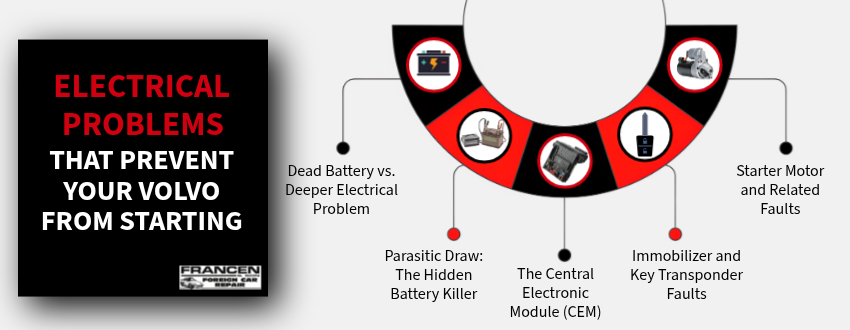
Immobilizer and Key Transponder Faults
Volvo’s SIPS (Supplemental Inflatable Protection System) and IMMO (immobilizer) systems are tightly integrated with the CEM. If the transponder chip in your key has failed, or if the CEM cannot read the key’s rolling code, the fuel injection and ignition will not be authorized and the engine will crank without firing. Symptoms include an engine that cranks at normal speed (eliminating the battery as the primary fault) but refuses to start, often with an immobilizer or key warning light on the instrument cluster.
Key transponder issues can also develop after a dead battery event, particularly if the replacement battery wasn’t connected with the vehicle in the correct mode. Some Volvo models require a relearning procedure after battery changes involving certain module resets.
Starter Motor and Related Faults
If the engine produces no cranking sound — just a single click or total silence — with a battery that tests good under load, the fault moves to the starter motor, starter relay, or the inhibitor switch. On automatic transmission Volvos, the neutral safety switch prevents starting in any gear but Park or Neutral; a worn or misadjusted inhibitor switch can produce a no-start in Park that looks electrical when it’s actually mechanical.
The starter relay, located in the main fusebox, is an inexpensive component that can fail and prevent the starter from receiving the activation signal. A relay swap is always worth confirming before committing to starter motor replacement.
Contact Francen & Son in Algonquin
If your Volvo won’t start and you’re unsure whether the cause is the battery, the CEM, the immobilizer, or something else, contact Francen & Son at (847) 658-9500 or visit us at 1650 E Algonquin Rd, Algonquin, IL 60102. We specialize in foreign car repair and have the diagnostic tools to identify the correct root cause the first time.
Frequently Asked Questions
Why does my Volvo crank but not start after sitting for a few days?
If the car sits for several days and won’t start, a parasitic battery drain is the most likely explanation. Have the battery load-tested and the quiescent current draw measured to identify whether the drain is within normal range or caused by a module staying active after shutdown.
Can a software update or CEM reset fix a Volvo no-start?
Sometimes — CEM faults related to corrupted software or failed initialization routines can be resolved with a reflash or reset using Volvo VIDA software. Whether a reset resolves the issue depends on whether the module hardware is intact. A full diagnostic scan determines whether it’s a software fault or a hardware failure.
My Volvo shows an immobilizer light but the key is fine — what else could it be?
The immobilizer warning can appear if the CEM isn’t communicating correctly with the key transponder reader coil around the ignition cylinder, even if the key itself is functional. A broken or disconnected antenna ring around the ignition switch is worth inspecting, as this is a known failure point on older Volvo models.
Should I replace the battery myself or have it done at a shop?
We recommend having the battery tested and replaced professionally on modern Volvos. Some models require battery registration with the BCM after replacement to ensure correct charge management. An unregistered replacement battery can be undercharged or overcharged by the alternator, shortening its life.